Watch Dragon Ball Baby Saga Online Free English Dubbed
| Dragon Brawl GT | |||
|---|---|---|---|
| | |||
| Dragon Ball GT ドラゴンボールGT Doragon Bōru Jī Tī | |||
| Genre | Action, Adventure, Comedy, Fantasy, Science fiction, Martial arts | ||
| Anime series: Dragon Ball GT | |||
| Directed by | Osamu Kasai | ||
| Studio | Toei Blitheness | ||
| Series Composition | Aya Matsui (#1-50) | ||
| Written by | Aya Matsui | ||
| Licensor | Funimation | ||
| Network | Fuji Television receiver | ||
| |||
| Original run | Feb 7, 1996 — Nov 19, 1997 | ||
| No. of episodes | 64 | ||
Dragon Ball GT (ドラゴンボールGT , Doragon Bōru Jī Tī , GT standing for "One thousand Tour", commonly abbreviated every bit DBGT ) is i of two sequels to Dragon Ball Z, whose material is produced but by Toei Blitheness, and is not adapted from a preexisting manga series. The Dragon Brawl GT serial is the shortest of the Dragon Ball series, consisting of only 64 episodes; equally opposed to its predecessor, Dragon Ball Z, which consisted of 291 episodes, Dragon Ball, which consisted of 153, and its successor series Dragon Brawl Super, with 131 episodes. The series spanned 64 episodes and is concluded by the Tv set special Dragon Brawl GT: A Hero's Legacy.
Contents
- 1 Plot
- 2 Overview
- 2.1 Series History
- 2.2 Toriyama'due south involvement and catechism debate
- iii Sagas
- four English adaptations
- 4.ane US (Funimation) version
- 4.2 International (Blue Water) version
- five Live stage prove
- 6 Telly special
- 7 Release
- seven.1 Funimation Remastered Box Sets
- 8 Manga
- 9 Cast
- 10 Staff
- xi Theme Songs
- 12 Reception
- 13 Gallery
- 14 See also
- fifteen External links
- 16 References
- 17 Site Navigation
Plot
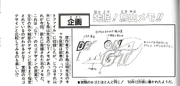
The GT logo, designed by Akira Toriyama (Perfect Files)
The series continues the adventures of Goku, who is turned back into a child by Emperor Pilaf accidentally wishing this using the Blackness Star Dragon Assurance in the beginning of the series and is forced to travel across the galaxy to remember them. The starting time half of the series focuses on Goku, Pan, and Trunks, while the 2d one-half brings back almost of the prominent characters from Dragon Ball and Dragon Ball Z. The series follows the Dragon Team against far more powerful foes such as the Luud Cult, the Machine Mutants, Infant, Super 17, and the Shadow Dragons.
The series is most commonly referred to as taking place 5 years after the Peaceful World Saga,[1] [ii] though in promotional fabric for the English dub information technology was referred to as occurring 10 years afterward.[iii] [4] It was likewise on one occasion instead referred to as taking place six years later.[five]
Overview
Series History
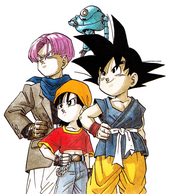
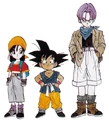
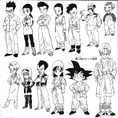
GT master characters as designed by Akira Toriyama
The commencement two anime series were directly based off the Dragon Ball manga, which took much longer to produce than the anime did. This often resulted in "filler"; a notable instance beingness that the end of Goku's battle with Frieza lasts much longer than Frieza'south predicted "v minutes". Since Dragon Ball GT was not based on the manga, no filler was required. Equally a effect, four entire sagas (the Black Star Dragon Ball Saga, the Baby Saga, the Super 17 Saga, and the Shadow Dragon Saga) were completed in merely 64 episodes. The music for Dragon Brawl GT was equanimous and written by Akihito Tokunaga, replacing Shunsuke Kikuchi who is now retired afterwards composing his last score for the final episode of Dragon Ball Z and the character designs for Dragon Ball GT were created by Katsuyoshi Nakatsuru.
Dragon Ball GT began on Fuji TV at 7:30 p.thousand. on Wednesday, Feb 7, 1996, exactly one week after the final episode of Dragon Ball Z. It ran for 64 episodes, the concluding of which aired on November 19, 1997. The series boilerplate rating was fourteen.half dozen%, with its maximum being 19.7% (Episode 02) and its minimum being ix.6% (Episode 21). The serial has also been aired beyond Nihon by the anime television network, Animax, where it is currently existence regularly circulate. Unlike the Dragon Ball and Dragon Ball Z serial, the creator Akira Toriyama had only minor involvement in the testify'due south early stages, setting forth the initial premise of the series, likewise as creating designs for most of the villains and main characters, including newcomer Giru. Early episodes are much more comedic in tone, reminiscent of early Dragon Ball. The subsequently episodes, withal, are action-packed and characteristic the same sort of dramatic tone that existed in Dragon Ball Z. The series ran for 64 episodes, ending after two years on the air. GT was followed by Dragon Ball Z Kai, a condensed remake of Dragon Brawl Z, and Dragon Brawl Super, which features a new plotline set up directly later on Dragon Brawl Z, taking place between episodes 288 and 289 and began airing in the summertime of 2015.
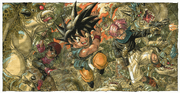
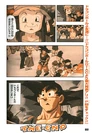
Goku, Pan, and Trunks adventuring, fatigued by Toriyama (Weekly Jump No.3-four, 1996)
At that place are two companion books to the series, called the Dragon Ball GT: Perfect File, released in May 1997 and December 1997 past Shueisha'due south Spring Comics Selection banner. They include series information, illustration galleries, behind-the-scenes data, and more. They were out of print for many years, but were re-released in April 2006 and this edition is withal in print.
On June xv, 2005, Toei Animation (in conjunction with distributor Pony Canyon) released the entire series (including the Gokū Jr. Tv special) in an extremely limited-edition DVD boxed set (called "Dragon Box GT"), along with a Dragon Radar remote control and an exclusive booklet. While the set features remastered audio and video, there are no subtitles, English language or otherwise. It's as well unavailable to the general public due to its scarce numbers and its huge toll.[6]
Toriyama'southward interest and canon debate
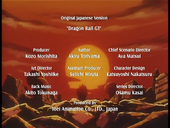
Akira Toriyama credited as writer in Dragon Ball GT
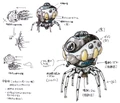
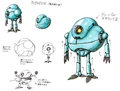
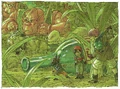
Akira Toriyama is credited equally author in the ending credits of Dragon Ball GT; he oversaw the series' production, this was the same process that was used during the production of the anime serial Dragon Ball and Dragon Ball Z. He came up with the name of the series, drew a rough design for the GT logo, he designed the GT advent of the series master cast, and he designed the appearances of Giru and the Thousand Tour Spaceship used in the Black Star Dragon Brawl Saga.[7] He also drew at least iii color pictures of Goku, Pan, and Trunks adventuring on various planets (Monmaasu, Rudeeze, and an area in Hell).[8]
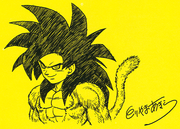
Super Saiyan 4 Goku, drawn by Akira Toriyama
Toriyama seems to have positive feelings towards his work's continuation. He refers to his fellow GT staff as "excellent", praising in particular the series animator, "animator Nakatsuru-kun is amazingly skilled, and mastered the peculiarities of my drawings". Toriyama has said that watching GT makes him happy, and that he enjoys it.[9] Toriyama drew a promotional version of Super Saiyan 4 Goku exclusively for the Dragon Box GT. Characters and events from GT have also been included in recent Dragon Ball video games.
Some fans exercise not consider GT to be an official installment of the series, most oft citing that the series was not directly adapted from a Toriyama manga. Like Dragon Ball and Dragon Ball Z, GT contains pocket-size elements inconsistent with prior anime events. Nonetheless, GT has the fewest inconsistencies of the first three anime serial, making information technology hard to brunt the few that exist equally a reason for the serial to be ready bated as unofficial.
On the same Dragon Box that Toriyama illustrated the Super Saiyan four form, he refers to the series equally "a k side-story of the original Dragon Ball".[9] This controversial statement is interpreted by some fans to mean that the serial is considered by Toriyama as an official continuation of his manga, and past others to mean the opposite. In December 2014, Funimation English voice player and voice director Christopher Sabat said that GT is "not even canon anymore",[x] likely significant that the release of Dragon Ball Z: Battle of Gods superseded GT as official content, in Sabat's opinion. Notably, Sabat's statement is one of very few recorded usages of the word "catechism" by anyone involved in the production of whatsoever Dragon Ball media.
Sagas
- Blackness Star Dragon Ball Saga (Episodes one~sixteen)
- Baby Saga (Episodes 17~xl)
- Super 17 Saga (Episodes 41~47)
- Shadow Dragon Saga (Episodes 48~64)
English adaptations
U.s. (Funimation) version
Funimation'southward GT logo. Information technology is identical to the original logo used in the original Japanese dub and the Blue Water English dub, simply with few minor details added. This logo was unveiled in the spring of 2003.
The English language adaptation of Dragon Ball GT ran on Drawing Network between November 7, 2003 and April xvi, 2005, but the version past FUNimation had a major alteration: the offset 16 episodes of the series, the "Black Star Dragon Ball Saga", were cutting and replaced past a unmarried Usa-merely episode which summarized the episodes; this became the new series premiere and the rest of the episodes began with episode 17. This edit was implemented past the producers of the English language dub to prevent viewers from perhaps beingness put-off by these differently-toned early on episodes. The 16 missing episodes take since been released as the "Lost Episodes".[11] When first aired, Funimation recorded a new musical score equanimous past Mark Menza and the openings and closings were replaced with something completely different from the original. For example, a rap was used for the opening and used dissimilar clips from the show to make upward the visuals. Nonetheless, when FUNimation released the series to 2 remastered boxed sets in 2008, the original Japanese music was restored, and English versions of the opening and all four closings were created, which are all very close to the original versions. From early on 2012 until January 2015, the FUNimation version, including the "lost episodes", was shown on Nicktoons.
International (Blue Water) version
Outside of the United States, (excluding Australia and New Zealand) a dissimilar English dub of the series was aired, featuring the voice actor of Canadian vocalism interim grouping Blue Water Studios. While the voices are dissimilar from both the American and international English dubs of Dragon Ball Z, the original groundwork music by Akihito Tokunaga was kept, the episodes were aired in their proper order, and the scripts were kept much closer to the original Japanese version. However, the international version kept the original Japanese theme song merely used English subtitles. An English language version of the GT theme song was sung while this dub aired on Toonami in the UK, however these were different lyrics to the original song and not a direct translation.
Live stage show
- Dragon Brawl GT (live show)
TV special
- Dragon Ball GT: A Hero's Legacy (悟空外伝! 勇気の証しは四星球 , Gokū Gaiden! Yūki no Akashi wa Sūshinchū , lit. "Goku Sidestory! The Proof of his Courage is the 4-Star Brawl")
Release
Funimation Remastered Box Sets
In 2008 FUNimation began production of remastering the unabridged Dragon Brawl GT serial similar to the remastering process of Dragon Ball Z. Unlike the Dragon Brawl Z remastered sets, the Dragon Ball GT Remastered Season Sets are presented in a 4:3 full frame and come with 5 discs rather than 6. The GT Sets are not presented in high definition. Just like the Dragon Ball Z remastered sets, the GT Sets include English dialogue with original Japanese background music, 5.1 surround sound, English language dialogue with United states of america broadcast stereo and original Japanese mono. Both Dragon Ball GT Season Box sets include a booklet including graphic symbol profiles" and an episode guide.
Dragon Ball GT: Flavour One was released on Dec 9, 2008. The box set includes the Black Star Dragon Ball Saga and most of the Babe Saga, spanning the start 34 episodes over 5 discs.
Dragon Ball GT: Season Two was released on February 10, 2009. The box set up includes the last 6 episode of the Baby Saga, Super 17 Saga and Shadow Dragon Saga, spanning the final 30 episodes concluding the series. The TV special Dragon Brawl GT: A Hero'due south Legacy is included equally part of the Box set.
On September 21, 2010 FUNimation released Dragon Brawl GT: The Consummate Series which featured all 64 episodes of the show and Dragon Ball GT: A Hero'south Legacy.
| Dragon Brawl GT Season ane Dragon Ball GT Flavour 2 Dragon Ball GT The Complete Series Dragon Ball GT Book 1 Dragon Ball GT Volume 2 Dragon Ball GT Volume three Dragon Brawl GT Volume 4 Dragon Ball GT Book five Dragon Ball GT Volume half dozen Dragon Ball GT Book 7 Dragon Ball GT Volume 8 Dragon Brawl GT Volume 9 Dragon Ball GT Volume x Dragon Ball GT Volume eleven |


| Flavour | Release Appointment | Sagas |
|---|---|---|
| Dragon Ball GT: Season ane | Dec 9, 2008 | Black Star Dragon Ball and Babe Saga |
| Dragon Ball GT: Season two | Feb 10, 2009 | Super 17, Shadow Dragon Sagas and Dragon Ball GT: A Hero's Legacy |
| Dragon Ball GT: The Consummate Series | September 21, 2010 | All 64 episodes and Dragon Ball GT: A Hero's Legacy |
Manga
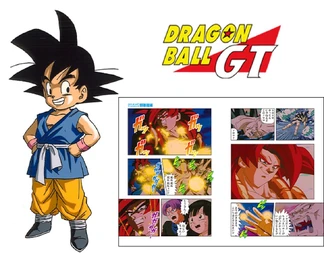
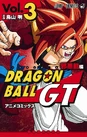
Dragon Ball GT anime manga full color edition
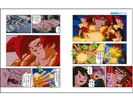
The "Anime Comics" manga version of Dragon Ball GT began in the January 2014 event of Saikyō Jump, starting with the Evil Dragons Arc. Because the original story comes from an anime rather than a manga, this media is sometimes referred to as an animanga, a portmanteau of "anime" and "manga".
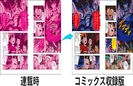
Presented in full color (equally opposed to the limited-color version from serialization), Shueisha released the get-go three volumes of Dragon Ball GT in December 4, 2019, with pricing for ¥ane,000 each (plus tax), and covered the entirety of the serial' Evil Dragons arc. Previously, theDragon Brawl GT anime comic was exclusive to its Saikyō Jump serialization.
| Dragon Ball GT: Volume 1 (Evil Dragons Arc) Dragon Ball GT: Book 2 (Evil Dragons Arc) Dragon Ball GT: Volume three (Evil Dragons Arc) Dragon Ball GT Anime manga 2014 promo Dragon Ball GT Anime Manga 2019 promo Dragon Ball GT Anime Manga (limited-colour) Dragon Ball GT Anime Manga (limited-colour) Express color and full color comparing Dragon Ball GT anime manga full color edition) |


Cast
| Grapheme proper name | Japanese voice | Funimation phonation | Blue Water vox |
|---|---|---|---|
| Goku | Masako Nozawa | Stephanie Nadolny (child) Sean Schemmel (adult/Super Saiyan iv) | Zoe Slusar (child) Jeremiah Yurk (adult/Super Saiyan 4) |
| Goten | Masako Nozawa | Robert McCollum | Scott Hendrickson |
| Trunks | Takeshi Kusao | Eric Vale | Matthew Erickson |
| Giru | Shinobu Satouchi | Sonny Strait | Nathan Simpson |
| Uub | Atsushi Kisaichi | Sean Michael Teague | Scott Roberts (1st episode) Brendan Hunter |
| Pan | Yūko Minaguchi | Elise Baughman | Caitlynne Medrek |
| Vegeta | Ryō Horikawa | Christopher Sabat | Roger Rhodes |
| Bulma | Hiromi Tsuru | Tiffany Vollmer | Kristin Nowosad |
| Bulla | Hiromi Tsuru | Pariksi Fakhri | Leda Davies |
| Gohan | Masako Nozawa | Kyle Hebert | Scott Roberts |
| Videl | Yūko Minaguchi | Lucy Small | Jennifer Holder |
| Chi-Chi | Naoko Watanabe | Cynthia Cranz | Debbie Munro |
| Krillin | Mayumi Tanaka | Sonny Strait | Dan Gascon |
| Android 18 | Miki Itō | Meredith McCoy | Jennifer Bain |
| Marron | Tomiko Suzuki | Meredith McCoy | Lori Barnes Smith |
| Dende | Hiro Yuki | Justin Cook | Jeffrey Watson |
| Mr. Popo | Toku Nishio | Christopher Sabat | Dave Pettitt |
| Piccolo | Toshio Furukawa | Christopher Sabat | Ethan Cole |
| Emperor Pilaf | Shigeru Chiba | Chuck Huber | Dean Galloway |
| Shu | Tesshō Genda | Chris Cason | Jonathan Love |
| Mai | Eiko Yamada | Julie Franklin | Debbie Munro |
| Mr. Satan | Daisuke Gōri | Chris Rager | Dave Pettitt |
| Majin Buu | Kōzō Shioya | Josh Martin | Corby Proctor |
| Master Roshi | Hiroshi Masuoka | Mike McFarland | Dean Galloway |
| Tien Shinhan | Hirotaka Suzuoki | John Burgmeier | |
| Chiaotzu | Hiroko Emori | Monika Antonelli | |
| Yamcha | Toru Furuya | Christopher Sabat | |
| Puar | Naoko Watanabe | Monika Antonelli | |
| Kibito Kai | Shinichirō Ōta | Kent Williams | Roger Rhodes |
| Old Kai | Reizō Nomoto | Kent Williams | Steve Olson |
| Sugoro | Bin Shimada | Brice Armstrong | Jonathan Love |
| Shusugoro | Mayumi Tanaka | John Burgmeier | Dan Gascon |
| Dr. Gero | Kōji Yada | Kent Williams | Jonathan Love |
| Dr. Myuu | Kazuyuki Sogabe | Duncan Brannan | Dave Pettitt |
| Full general Rilldo | Kiyoyuki Yanada | Andrew Chandler | Steve Olson |
| Baby | Yūsuke Numata | Mike McFarland | Adam Hunter |
| Android 17 | Shigeru Nakahara | Chuck Huber | Ethan Cole |
| Frieza | Ryūsei Nakao | Linda Young | Jennifer Bain |
| Cell | Norio Wakamoto | Dameon Clarke | Ben Jeffery |
| Rex Kai | Jōji Yanami | Sean Schemmel | Dean Galloway |
| Syn Shenron | Hidekatsu Shibata | Bob Carter/Christopher Sabat | Noah Umholtz |
| Shenron | Daisuke Gōri | Christopher Sabat | Dave Pettitt |
| Narrator | Joji Yanami | Andrew Chandler | Steve Olson |
Staff
- Director: Minoru Okazaki
- Serial Director: Osamu Kasai
- Episode Managing director: Hidehiko Kadoda, Hiroyuki Kakudou, Junichi Fujise, Kazuhito Kikuchi, Mitsuo Hashimoto, Osamu Kasai, Shigeyasu Yamauchi (ep 15), Takahiro Imamura, Yoshihiro Ueda
- Producer: Kōji Kaneda (Fuji Boob tube), Kōzō Morishita, Seiichi Hiruta (Toei Animation)
- Banana producer: Seiichi Hiruta
- Planning: Kenji Shimizu, Kōzō Morishita
- Series Composition & Chief Scenario Director: Aya Matsui
- Screenplay: Atsushi Maekawa (28 episodes), Aya Matsui (eleven episodes), Daisuke Yajima (20 episodes & 27, 28 episodes), Junki Takegami (v episodes), Masashi Kubota (v episodes), Toshinobu Oni (ten episodes)
- Storyboard: Shigeyasu Yamauchi (eps 15, 20), Kōzō Morishita (ep 61)
- In charge of product: Yuichi Suenaga
- Grapheme Pattern: Katsuyoshi Nakatsuru, Akira Toriyama (Principal characters minus Lazuli and Marron) (Uncredited)
- Fine art and Design: Takashi Yoshiike
- Art blueprint: Ryuuji Yoshiike, Tadanao Tsuji
- Art: Koji Sakaki, Tomoko Yoshida, Tsutomu Fujita
- Animation Managing director: Akira Inagami, Kazuya Hisada, Kazuya Kuda, Masayuki Uchiyama, Naoki Miyahara, Tadayoshi Yamamuro, Noboru Koizumi, Shingo Ishikawa, Takeo Ide, Toshiyuki Sugano, Yuuji Hakamada
- Music: Akihito Tokunaga
- Audio Manager: Nobuhiro Komatsu
- Sound Effects: Hidenori Arai
- Editing: Shinichi Fukumitsu
Theme Songs
- Opening: "Dan Dan Kokoro Hikareteku"
- Version 1: episodes 1~26 (on Hulu, episodes 1~40)
- Version 2: episodes 27~64 (on Hulu, episodes 41~64)
- Endings:
- "Hitori ja Nai": episodes 1~26
- "Don't You See!": episodes 27~41
- "Blue Velvet": episodes 42~50
- "Sabitsuita Auto Gun de Ima o Uchinukō": episodes 51~64
Reception
Due to series burnout, Dragon Ball GT never reached the same level of success as Dragon Brawl Z in Nihon (managing to get up to simply 14% ratings compared to Dragon Ball Zs peak of 25% and dip to thirteen.5%). However in America Dragon Brawl GT DVDs outsold Dragon Ball Z ones in 2003.[12]
Gallery
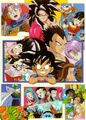
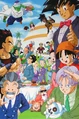
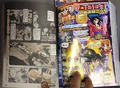
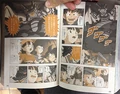
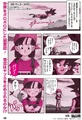
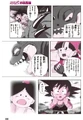
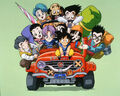
| Main characters designed and colored past Toriyama (Perfect Files) GT appearance of the serial main cast designed past Toriyama (Perfect Files) GT spaceship designed past Toriyama (Weekly Jump 52, 1995) Giru designed by Toriyama (Weekly Spring 52, 1995) Monmaasu scenery drawn by Toriyama (Weekly Jump 52, 1995) Rudeeze scenery drawn past Toriyama (Weekly Jump 52, 1995) The main serial cast on a Dragon Brawl GT poster Another poster showing the extended cast Dragon Ball GT anime comics Dragon Ball GT anime comics Dragon Brawl GT anime comics Dragon Ball GT anime comics GT Dragon Book storyboard designs from July 1995 |



Come across also
- List of Dragon Ball GT episodes
- Gohan subplot (Dragon Ball GT)
External links
- Official Toei Blitheness'south website
- Official FUNimation's website
- Nicktoons' official Dragon Ball GT folio
- Official Manga UK's website
- Official Madman's website
References
- ↑ Dragon Ball GT: Perfect File book 1
- ↑ Dragon Brawl Xenoverse
- ↑ Kanzenshuu's folio on Anime Insider Dec 2003 (#x)
- ↑ Kanzenshuu's folio on Shonen Jump (Result 5, May 2003)
- ↑ Kanzenshuu's article on Animerica April 2003 (Book 11, Number iv)
- ↑ Kanzentai's Guide on Dragon Boxes. kanzentai.
- ↑ Dragon Ball GT: Perfect File
- ↑ Monsters on this image appear in Hell in Dragon Brawl GT episode 64, "Until Nosotros See Again"
- ↑ 9.0 nine.one Dragon Ball GT DVD Box: Dragon Box GT "Dragon Book". kanzenshuu.
- ↑ https://www.youtube.com/watch?v=MbLq_NfLN9A
- ↑ Kanzenshuu's Newbie Guide. kanzenshuu.
- ↑ Anime Insider December 2003 (#10), "The QT on GT"
| Dragon Brawl Production Staff | |
|---|---|
| Companies | Bird Studio • Caramel Mama • Shueisha • Toei Blitheness |
| Writer(s) | Akira Toriyama • Naho Ooishi* • Toyotarou* • Yoshitaka Nagayama* |
| Administration | Takashi Matsuyama |
| Editors | Kazuhiko Torishima • Yū Kondō • Fuyuto Takeda • Shinichi Fukumitsu* • Daisuke Terashi* • Akio Iyoku* • Victory Uchida* |
| Directors | Minoru Okazaki • Akinori Nagaoka • Kazuhisa Takenouchi • Daisuke Nishio • Mitsuo Hashimoto • Takahiro Imamura • Shigeyasu Yamauchi • Yoshihiro Ueda • Masahiro Hosoda • Yasuhiro Nowatari |
| Producers | Keizo Shichijo • Kōzō Morishita • Kenji Shimizu • Tamio Kojima • Chiaki Imada • Rikizō Kayano • Tomio Anzai • Tsutomu Tomari • Tan Takaiwa • Seiichi Hiruta • Kōji Kaneda • Gyarmath Bogdan • James Wong |
| Production managers | Kazumi Fujioka • Matsuji Kishimoto • Take Torimoto • Akihiko Yamaguchi • Yuichi Suenaga |
| Screenwriters | Takao Koyama • Toshiki Inoue • Keiji Terui • Yoshifumi Yuki • Katsuyuki Sumisawa • Hiroshi Toda • Aya Matsui • Atsushi Maekawa • Yūsuke Watanabe • Ben Ramsey • Akira Toriyama |
| Art directors | Mitsuo Shindō • Yoshiyuki Yamamoto • Kunio Kaneshima • Iwamitsu Ito • Hiromitsu Shiozaki • Yuji Ikeda • Shigenori Takada • Masahiro Shimanuki • Ryuuji Yoshiike • Hiroshi Katō • Teppei Horita |
| Anime designers | Minoru Maeda • Katsuyoshi Nakatsuru • Tadayoshi Yamamuro • Naohiro Shintani |
| Animators | Masayuki Uchiyama • Naoki Miyahara • Naotoshi Shida |
| Special Effects | Hidenori Arai • Nao Ōta |
| Music composers | Shunsuke Kikuchi • Chiho Kiyooka • Akihito Tokunaga • Kenji Yamamoto • Norihito Sumitomo • Shuki Levy • Kussa Mahchi • Ron Wasserman • Bruce Faulconer • Julius Dobos • Mike Smith • Scott Morgan • Andy Baylor • Dale Kelly • Mark Akin • Scot Risch • Tom Keenlyside • John Mitchell • David Iris • Mark Menza • Dave Moran • Nathan Johnson |
| Vocalists | Hironobu Kageyama • Takayoshi Tanimoto • Ayumi Hamasaki |
| Vocalism actors | Japanese vocalism actors • Blue H2o vocalization actors • Ocean voice actors • FUNimation voice actors |
| Series | Dr. Slump • Dragon Ball manga • Dragon Ball anime • Dragon Brawl Z • Dragon Ball GT • Dragon Ball Kai • Dragon Brawl Super manga • Dragon Ball Super anime • Dragon Ball video games • Related manga |
Source: https://dragonball.fandom.com/wiki/Dragon_Ball_GT
0 Response to "Watch Dragon Ball Baby Saga Online Free English Dubbed"
Publicar un comentario