The Adventures Sherlock Holmes the Final Problem Art Model
| Professor Moriarty | |
|---|---|
| Sherlock Holmes grapheme | |
 Professor James Moriarty, analogy by Sidney Paget which accompanied the original publication of "The Final Problem" | |
| First appearance | "The Terminal Problem" (1893) |
| Created by | Sir Arthur Conan Doyle |
| In-universe information | |
| Total proper noun | James Moriarty |
| Occupation | Professor of mathematics (former) Criminal mastermind |
| Family | One or two brothers[1] |
| Nationality | British |
Professor James Moriarty is a fictional character and criminal mastermind created by Sir Arthur Conan Doyle to be a formidable enemy for the writer's fictional detective Sherlock Holmes. He was created primarily as a device by which Doyle could impale Holmes and end the hero's stories. Professor Moriarty first appears in the curt story "The Adventure of the Concluding Problem", commencement published in The Strand Magazine in December 1893. He too plays a part in the final Sherlock Holmes novel The Valley of Fear, only without a direct advent. Holmes mentions Moriarty in 5 other stories: "The Chance of the Empty Business firm", "The Chance of the Norwood Builder", "The Adventure of the Missing 3-Quarter", "The Take chances of the Illustrious Customer", and "His Last Bow".
Moriarty is a Machiavellian, consulting criminal mastermind who uses his intelligence and resources to provide criminals with crime strategies and sometimes protection from the police, all in exchange for a fee or a cut of profit. Holmes likens Moriarty to a spider at the center of a web and calls him the "Napoleon of crime", a phrase Doyle lifted from a Scotland Yard inspector referring to Adam Worth, a existent-life criminal mastermind and one of the individuals upon whom the character of Moriarty was based. Despite his appearing only twice in Doyle's original stories, afterwards adaptations and pastiches take often given Moriarty greater prominence and treated him as Sherlock Holmes' archenemy.
Appearances in works [edit]
Professor Moriarty's kickoff appearance occurred in the 1893 short story "The Adventure of the Final Trouble" (set in 1891).[2] The story features consulting detective Sherlock Holmes revealing to his friend and biographer Doctor Watson that for years now he has suspected many seemingly isolated crimes to actually all be the machinations of a single, vast, and subtle criminal system. Afterwards investigation, he has uncovered Professor Moriarty as a mastermind who provides strategy and protection to criminals in commutation for obedience and a share in their profits. Moriarty realizes Holmes is enlightened of his operation and confronts him in person, threatening decease if further interference is done.
Holmes describes Moriarty'due south physical advent to Watson, maxim the professor is extremely tall and thin, clean-shaven, pale, and ascetic-looking. He has a brow that "domes out in a white bend", deeply sunken eyes, and shoulders that are "rounded from much report". His face protrudes forrard and is always slowly aquiver from side to side "in a curiously reptilian way".[3] Holmes mentions that during their meeting, Moriarty remarked in surprise, "You accept less frontal development than I should have expected," indicating the criminal believes in phrenology.[2]
Holmes ignores the threat and delivers appropriate testify to the constabulary then Moriarty and those who operate his network will face justice in a few days. Knowing the mastermind and his trusted lieutenants intend to kill him before they hide or are arrested, Holmes flees to Switzerland, and Watson joins him. The mastermind follows, his pursuit ending when he confronts Holmes at the acme of the Reichenbach Falls. Watson does non witness the confrontation just arrives later to find signs of hand-to-hand combat occurring at the cliff edge near the waterfall, indicating the battle ended with both men falling to their deaths. Watson besides finds a goodbye notation left behind by Holmes that Moriarty immune him to write before their battle.
Moriarty plays a direct role in only one other Holmes story, The Valley of Fearfulness (1914), gear up before "The Final Problem" but written afterwards. In The Valley of Fear, Holmes attempts to prevent Moriarty's agents from committing a murder. A policeman who interviewed Moriarty tells Holmes that the professor has a painting by Jean-Baptiste Greuze hanging on his office wall. Learning this, Holmes mentions the great value of another painting by the same creative person, pointing out such works could not have been purchased on a university professor'due south bacon. The work referred to is La jeune fille à l'agneau ;[4] which some commentators[5] have described as a pun by Doyle on a famous Thomas Gainsborough painting, the Portrait of Georgiana, Duchess of Devonshire,[6] which was taken from the Thomas Agnew and Sons fine art gallery. The gallery believed Adam Worth (the criminal who helped inspire Doyle to create Moriarty) was responsible, but was unable to prove the claim.[5]
Holmes mentions Moriarty reminiscently in five other stories: "The Adventure of the Empty Firm" (the immediate sequel to "The Last Problem"), "The Hazard of the Norwood Builder", "The Adventure of the Missing Three-Quarter", "The Adventure of the Illustrious Client", and "His Terminal Bow" (the final gamble in Sherlock'southward canon timeline, taking place years later on he has officially retired).
Dr. Watson, fifty-fifty when narrating, never meets Moriarty (simply getting afar glimpses of him in "The Final Problem") and relies upon Holmes to relate accounts of the detective'due south feud with the criminal. Doyle is inconsistent on Watson'due south familiarity with Moriarty. In "The Terminal Problem", Watson tells Holmes he has never heard of Moriarty, while in "The Valley of Fear", set earlier on, Watson already knows of him equally "the famous scientific criminal."
In "The Empty Business firm", Holmes says Moriarty deputed a powerful air gun from a bullheaded German language mechanic surnamed von Herder, a weapon after used past the professor'south employee/acolyte Colonel Moran. Information technology closely resembles a cane, allows piece of cake concealment, is capable of firing revolver bullets at long range, and makes very little noise when fired, making it ideal for criminal sniping. Moriarty also has a marked preference for organising lethal "accidents" to befall his targets. His attempts to kill Holmes include falling masonry and a speeding horse-drawn vehicle. He is as well responsible for stage-managing the decease of Birdy Edwards, making information technology appear the human being was lost overboard while sailing to South Africa.[seven]
Personality [edit]
Moriarty is highly ruthless, shown by his steadfast vow to Sherlock Holmes that "if you are clever enough to bring devastation upon me, rest assured that I shall exercise as much to you".[eight] Moriarty is categorised past Holmes as an extremely powerful criminal mastermind adept at committing any barbarism to perfection without losing whatever sleep over information technology. It is stated in "The Final Problem" that Moriarty does non directly participate in the activities he plans, just only orchestrates the events or provides the plans that volition lead to a successful crime. What makes Moriarty so dangerous is his extremely cunning intellect:
He is a man of good nascency and fantabulous education, endowed by nature with a phenomenal mathematical faculty. [...] But the homo had hereditary tendencies of the most diabolical kind. A criminal strain ran in his claret, which, instead of being modified, was increased and rendered infinitely more than unsafe past his boggling mental powers. [...] He is the Napoleon of crime, Watson. He is the organiser of half that is evil and of nearly all that is undetected in this great city...
—Holmes, "The Final Trouble"
Holmes echoes and expounds this sentiment in The Valley of Fear, stating:
The greatest schemer of all time, the organizer of every devilry, the decision-making brain of the underworld, a encephalon which might take made or marred the destiny of nations—that's the man! But then aloof is he from general suspicion, and so allowed from criticism, so admirable in his management and self-effacement, that for those very words that yous take uttered he could hale you to a court and emerge with your year'south pension as a solatium for his wounded graphic symbol. [...] Foulmouthed doctor and slandered professor—such would be your respective roles! That's genius, Watson.
—Holmes, The Valley of Fright
Moriarty respects Holmes's intelligence, stating: "It has been an intellectual treat for me to see the manner in which you [Holmes] have grappled with this case." Nevertheless, he makes numerous attempts upon Holmes'southward life through his agents. He shows a peppery disposition, becoming enraged when his plans are thwarted, resulting in his being placed "in positive danger of losing my liberty". While personally pursuing Holmes at a train station, he furiously elbows aside passengers, heedless of whether this draws attention to himself.
Doyle's original motive in creating Moriarty was obviously his intention to kill Holmes off.[9] "The Terminal Trouble" was intended to exist exactly what its championship says; Doyle sought to sweeten the pill by letting Holmes become in a blaze of glory, having rid the world of a criminal so powerful and dangerous that whatever further task would be trivial in comparison (as Holmes says in the story itself). Eventually, even so, public pressure and financial troubles impelled Doyle to bring Holmes back. While Doyle conceded to revealing that Holmes did non die during "The Terminal Problem" (as Watson mistakenly concludes), he chose not to undo Moriarty's death in a similar fashion. For this reason, the later novel The Valley of Fear features Moriarty equally an agile villain but is specified to take place before the events of "The Final Problem".[ten]
Fictional character biography [edit]
As established in Doyle's canon, Moriarty first gains recognition at the age of 21 for writing "a treatise upon the Binomial Theorem", which leads to his existence awarded the Mathematical Chair at i of England's smaller universities. Moriarty later authors a much respected work titled The Dynamics of an Asteroid. After he becomes the subject of unspecified "dark rumours" in the academy town, he is compelled to resign his teaching post and go out the area.[eleven] He moves to London, where he establishes himself every bit an "army coach", a private tutor to officers preparing for exams.[3] He becomes a consulting criminal mastermind for various London gangs and criminals (it is uncertain if he was already doing this before leaving his teaching post). When multiple plans of his are hampered or undone by Sherlock Holmes, Moriarty targets the consulting detective.[2]
Multiple pastiches and other works outside of Doyle's stories purport to provide additional information about Moriarty's background. John F. Bowers, a lecturer in mathematics at the University of Leeds, wrote a natural language-in-cheek article in 1989 in which he assesses Moriarty'southward contributions to mathematics and gives a detailed description of Moriarty's background, including a argument that Moriarty was born in Ireland (an thought based on the fact that the surname is Irish gaelic in origin).[12] [xiii] The 2005 pastiche novel Sherlock Holmes: The Unauthorized Biography likewise reports that Moriarty was born in Ireland, and states that he was employed as a professor by Durham University.[14] According to the 2020 audio drama Sherlock Holmes: The Vox of Treason, written by George Mann and Cavan Scott, Moriarty was a professor at Stonyhurst Higher (where Arthur Conan Doyle was educated and knew 2 students with the surname Moriarty).[fifteen]
Family [edit]
The stories give contradictory indications well-nigh Moriarty'due south family. In his showtime appearance in "The Final Problem" (1893), the villain is referred to but as "Professor Moriarty". Watson mentions no forename but does refer to the name of another family fellow member when he writes of "the contempo letters in which Colonel James Moriarty defends the memory of his brother". In "The Adventure of the Empty House" (1903), Holmes refers to Moriarty every bit "Professor James Moriarty". This is the only time Moriarty is given a first proper name, and oddly, it is the same as that of his purported brother.[3] In the 1914 novel The Valley of Fear (written later the preceding two stories, but set earlier), Holmes says of Professor Moriarty: "He is unmarried. His younger brother is a station chief in the west of England."[xvi] In Sherlock Holmes: A Drama in Four Acts, an 1899 phase play, of which Doyle was a co-author, the villain is named Professor Robert Moriarty.[17]
Writer Vincent Starrett suggested that Moriarty could have one brother (who is both a colonel and station master) or two brothers (one a colonel and the other a station master); he added that he considered the presence of ii siblings more than probable, and suggested that all three brothers were named James.[1] Author Leslie South. Klinger that suggested Professor Moriarty has an older blood brother named Colonel James Moriarty in addition to an unnamed younger blood brother. According to Klinger, writer Ian McQueen proposed that Moriarty does not actually have any brothers,[xviii] while Sherlockian John Bennett Shaw suggested, like Starrett, that at that place are three Moriarty brothers, all named James.[19] The premise that Professor James Moriarty has two brothers likewise named James was used in the radio serial The Further Adventures of Sherlock Holmes, the manga and anime series Moriarty the Patriot and the Kim Newman novel Moriarty: The Hound of the D'Urbervilles.
Adaptations [edit]
In addition to his appearances in Doyle's stories, in that location are many examples of Professor Moriarty in other media.
Real-world role models [edit]

"Moriarty" is an aboriginal Irish proper name[20] every bit is Moran, the surname of Moriarty's henchman, Sebastian Moran.[21] [22] Doyle himself was of Irish gaelic Cosmic descent, educated at Stonyhurst College, although he abandoned his family's religious tradition, neither marrying nor raising his children in the Catholic organized religion, nor cleaving to whatsoever politics that his indigenous background might presuppose. Doyle is known to take used his experiences at Stonyhurst as inspiration for details of the Holmes serial; among his contemporaries at the schoolhouse were ii boys surnamed Moriarty.[23]
ln addition to the master criminal Adam Worth, at that place has been much speculation amid astronomers and Sherlock Holmes enthusiasts that Doyle based his fictional graphic symbol Moriarty on the Canadian-American astronomer Simon Newcomb.[24] Newcomb was revered as a multitalented genius, with a special mastery of mathematics, and he had become internationally famous in the years earlier Doyle began writing his stories. More than to the point, Newcomb had earned a reputation for spite and malice, apparently seeking to destroy the careers and reputations of rival scientists.[25]
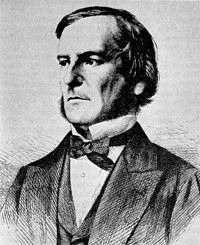
George Boole (circa 1860), another possible model for Moriarty
Moriarty may take been inspired in function by two real-world mathematicians. If the characterisations of Moriarty'south bookish papers are reversed, they describe real mathematical events. Carl Friedrich Gauss wrote a famous paper on the dynamics of an asteroid[26] in his early 20s, and was appointed to a chair partly on the strength of this result. Srinivasa Ramanujan wrote most generalisations of the binomial theorem,[27] and earned a reputation as a genius by writing articles that confounded the best extant mathematicians.[28] Gauss'south story was well known in Doyle's fourth dimension, and Ramanujan's story unfolded at Cambridge from early 1913 to mid 1914;[29] The Valley of Fright, which contains the comment about maths and so abstruse that no one could criticise it, was published in September 1914. Irish gaelic mathematician Des MacHale has suggested George Boole may have been a model for Moriarty.[30] [31]
Jane Stanford, in That Irishman, suggests that Doyle borrowed some of the traits and background of the Fenian John O'Connor Power for his portrayal of Moriarty.[32] In Moriarty Unmasked: Conan Doyle and an Anglo-Irish Quarrel, 2017, Stanford explores Doyle's relationship with the Irish literary and political community in London. She suggests that Moriarty, Ireland's Napoleon, represents the Fenian threat at the center of the British Empire. O'Connor, 2018, Power studied at St Jarlath's Diocesan College in Tuam, County Galway.[33] In his third and concluding yr he was Professor of Humanities. Equally an ex-professor, the Fenian leader successfully made a bid for a Westminster seat in County Mayo.[34]
Information technology is averred that surviving Jesuit priests at the preparatory school Hodder Place, Stonyhurst, instantly recognised the concrete clarification of Moriarty as that of the Rev. Thomas Kay, SJ, Prefect of Subject field, nether whose authorisation Doyle savage as a wayward student.[35] According to this hypothesis, Doyle every bit a individual joke has Inspector MacDonald draw Moriarty: "He'd take made a one thousand meenister with his sparse face and grey hair and his solemn-similar way of talking."[36]
The model which Doyle himself cited (through Sherlock Holmes) in The Valley of Fright is the London arch-criminal of the 18th century, Jonathan Wild. He mentions this when seeking to compare Moriarty to a real-earth character that Inspector Alec MacDonald might know, but it is in vain as MacDonald is not so well read every bit Holmes.
Legacy [edit]
T. S. Eliot's character Macavity the Mystery Cat is based on Moriarty.[37]
A Sherlockian club was formed past noted Sherlockian John Bennett Shaw[38] called "The Brothers Three of Moriarty", in award of Professor Moriarty and his 2 brothers.[39] The group held annual dinners in Moriarty, New Mexico.[39]
See also [edit]
- List of actors who have played Professor Moriarty
References [edit]
- ^ a b Starrett, Vincent (2016). 221B: Studies in Sherlock Holmes (Reprinted ed.). Pickle Partners Publishing. ISBN978-one-78720-133-0.
- ^ a b c Klinger, Leslie (ed.). The New Annotated Sherlock Holmes, Volume I (New York: West. Westward. Norton, 2005). p. xxxv. ISBN 0-393-05916-2.
- ^ a b c Cawthorne, Nigel (201). A Brief History of Sherlock Holmes. Robinson. pp. 216–220. ISBN978-0-7624-4408-3.
- ^ "Girl With A Lamb".
- ^ a b John Mortimer (24 Baronial 1997). "To Grab a Thief". The New York Times. . A review of THE NAPOLEON OF CRIME — The Life and Times of Adam Worth, Primary Thief by Ben Macintyre.
- ^ "A portrait of Georgiana Cavendish, Duchess of Devonshire past Thomas Gainsborough".
- ^ Epilogue, The Valley of Fright.
- ^ Doyle, Conan (1894). "The Adventure of the Final Problem". McClure's Magazine. Vol. 2. Astor Place, New York: J. J. Fiddling and Co. p. 104. Retrieved 11 Oct 2016.
- ^ Stashower, Daniel (1999). Teller of Tales: The Life of Arthur Conan Doyle. New York: Holt. p. 149. ISBN978-0805050745.
- ^ Miller, Ron. "Case Book: Doyle vs. Holmes". PBS.
- ^ Smith, Daniel (2014) [2009]. The Sherlock Holmes Companion: An Simple Guide (Updated ed.). London: Aurum Press. pp. 137–138. ISBN978-one-84513-458-seven.
- ^ Bowers, John F. (23 December 1989). "James Moriarty: a forgotten mathematician". New Scientist. pp. 17–19.
- ^ Arbesman, Samuel (2013). The One-half-Life of Facts: Why Everything We Know Has an Expiration Engagement. Penguin. pp. 85–86. ISBN9781591846512.
- ^ Rennison, Nick (ane December 2007). Sherlock Holmes: The Unauthorized Biography. pp. 67–68. ISBN9781555848736.
- ^ Sherlock Holmes: The Vocalisation of Treason (xvi March 2020). Aural Original Drama (audiobook). "Chapter 7."
- ^ Sir Arthur Conan Doyle. Sherlock Holmes: The Complete Novels and Stories. Vol. 2. Random House. p. 175.
- ^ "Sherlock Holmes, A Drama in Iv Acts. Human activity II".
- ^ Klinger, Leslie (ed.). The New Annotated Sherlock Holmes, Volume Ii (New York: W. Due west. Norton, 2005). p. 811. ISBN 0-393-05916-2.
- ^ Klinger, Leslie (ed.). The New Annotated Sherlock Holmes, Volume Three (New York: West. W. Norton, 2006). pp. 652–653. ISBN 0-393-05800-Ten.
- ^ Daniel Jones; A.C. Gimson (1977). Lowest's English Pronouncing Lexicon (14 ed.). London, UK: J.M. Dent & Sons.
- ^ Moran genealogy site; accessed 28 June 2014.
- ^ Moran profile, irishgathering.ie; accessed 28 June 2014.
- ^ Liukkonen, Petri. "Arthur Conan Doyle". Books and Writers (kirjasto.sci.fi). Finland: Kuusankoski Public Library. Archived from the original on eleven January 2008.
- ^ Schaefer, B. E., 1993, Sherlock Holmes and some astronomical connections, Journal of the British Astronomical Association, vol 103, no. one, pp. thirty–34. For a summary of this point, see this New Scientist article, also from 1993.
- ^ For example, see Newcomb's animosity to the career and works of Charles Peirce.
- ^ Gauss, Carl Friedrich (1809). Theoria motus corporum coelestium in sectionibus conicis solem ambientium. Hamburg, Deutschland: Friedrich Perthes and I.H. Besser. , as described in Donald Teets, Karen Whitehead, 1999 "The Discovery of Ceres: How Gauss Became Famous", Mathematics Magazine, vol 72, no 2 (April 1999), pp. 83–93
- ^ "Ramanujan Psi Sum". Mathworld.wolfram.com. Retrieved 30 January 2011.
- ^ Kanigel, R. (1991). The human who knew infinity: A life of the genius Ramanujan. Scribner. p. 168. ISBN978-0-671-75061-9.
- ^ Run into, for example, the book past Kanigel, The Human Who Knew Infinity
- ^ MacHale, Desmond (1995). "George Boole and Sherlock Holmes". The Legacy of George Boole. Cork, Ireland.
- ^ Lynch, Peter (15 November 2018). "Could Sherlock Holmes'southward true nemesis have been a mathematician?". The Irish Times . Retrieved 23 Nov 2018.
- ^ Stanford, Jane (2011). That Irishman: The Life and Times of John O'Connor Power . Dublin: The History Press, Ireland. pp. xxx, 124–27. ISBN978-1-84588-698-1.
- ^ Sherlock Holmes' Irish Nemesis, Library Corner, Tuam Herald, 28 February 2018.
- ^ Moriarty Unmasked, p.28.
- ^ "Letter from Stonyhurst achivist about Doyle'south experience there" (PDF).
- ^ The Valley of Fear, The Oxford Sherlock Holmes, p. 181
- ^ Dundas, Zach (2015). The Great Detective. Mariner Books. p. sixteen. ISBN978-0-544-70521-0.
- ^ Boström, Mattias (2018). From Holmes to Sherlock. Mysterious Printing. p. 386. ISBN978-0-8021-2789-one.
- ^ a b Boström, Mattias (2018). From Holmes to Sherlock. Mysterious Printing. pp. 405–406. ISBN978-0-8021-2789-1.
External links [edit]
- The Final Problem
- The Valley of Fearfulness
- Sherlock Holmes Public Library
- O'Connor, John J.; Robertson, Edmund F., "Professor Moriarty", MacTutor History of Mathematics archive, University of St Andrews
Source: https://en.wikipedia.org/wiki/Professor_Moriarty
0 Response to "The Adventures Sherlock Holmes the Final Problem Art Model"
Publicar un comentario